Black and Grey Tattoos in Beaumont, TX
Depth without colour — ornamental lacework, dotwork botanicals and detailed black-and-grey pieces built from tone alone.
What black-and-grey asks of a design
Strip the colour out and everything rests on tone. There’s nowhere to hide: the piece works because the values are right — real black holding the structure, mid-greys carrying the form, and clean skin left open where the light should be. Get that separation right and a black-and-grey tattoo reads clearly from across a room and stays that way for decades. Get it wrong and it turns into a grey smudge in five years.
That’s why I plan the values before anything else. Where the deepest blacks sit, how much untouched skin the design needs to breathe, how the greys step between them. It’s the same discipline as my neo-traditional work — bold structure first — just executed in a single colour.
Ornamental, dotwork and detailed work
Black-and-grey covers a lot of ground, and these are the lanes I work in most:
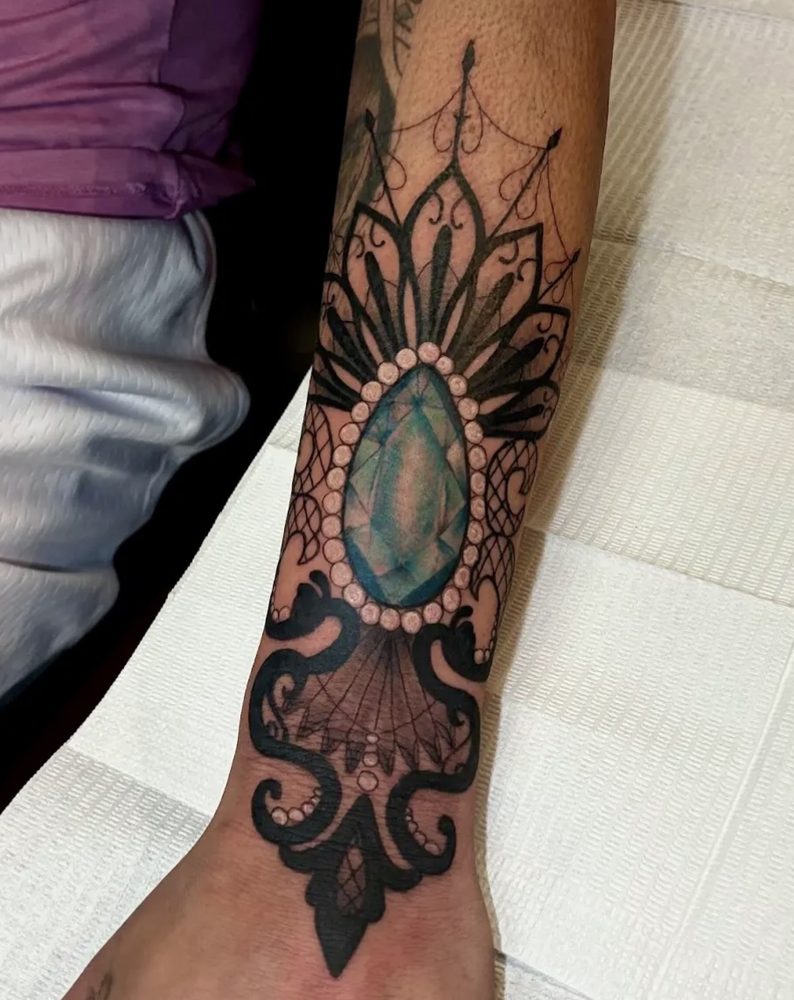
- Ornamental and lacework — symmetrical patterns, filigree, gems and drapery that follow the body’s lines rather than fighting them.
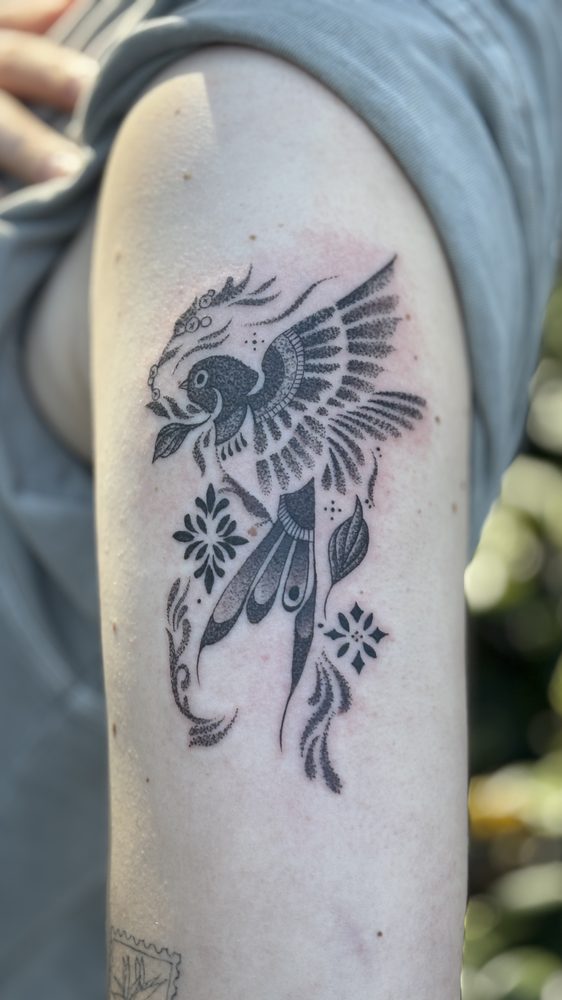
- Dotwork — tone built from stippling instead of smooth shading, giving an etched, engraved texture that suits botanicals and ornamental pieces beautifully.
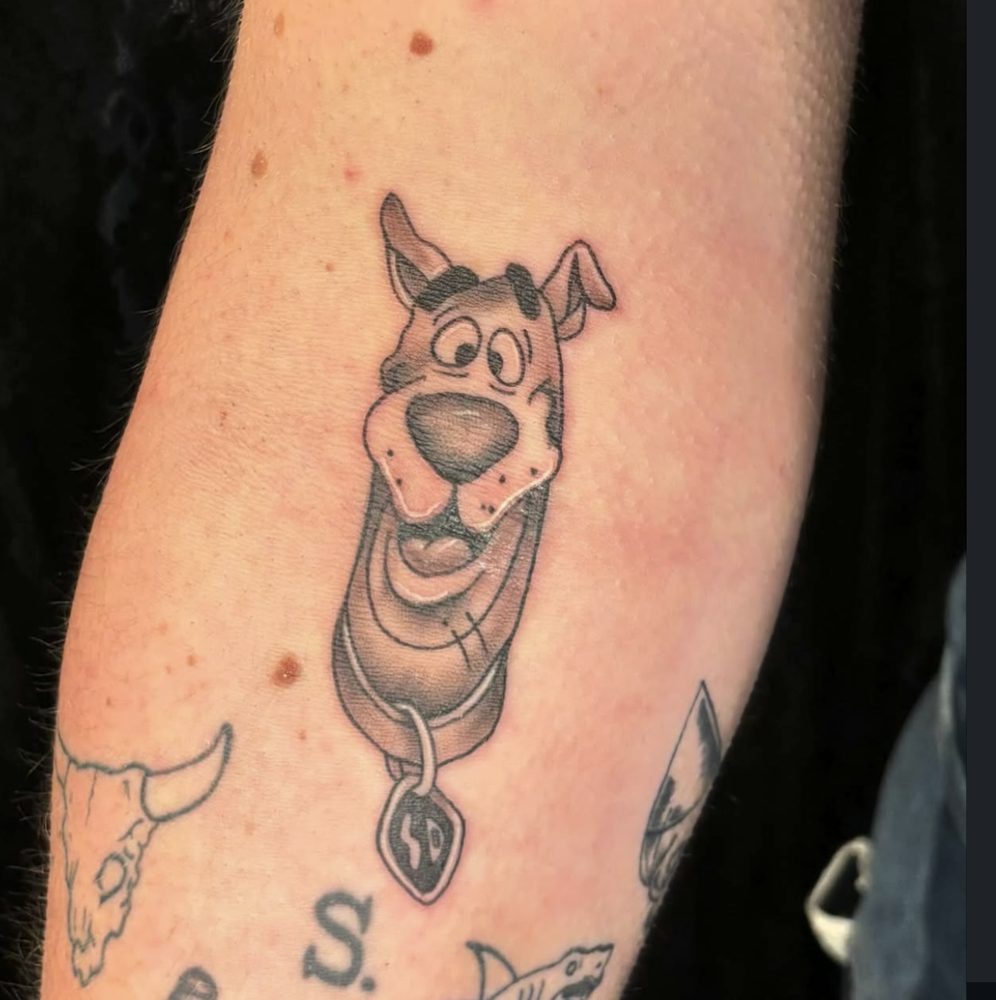
- Detailed black-and-grey — portraits, animals and objects rendered in full tonal range.
- Botanical linework — flowers and foliage with the weight and shadow that colour usually carries.
Why it holds up
Black ink is the most stable thing we put in skin. It keeps its density longer than most colours, which is why a well-built black-and-grey piece often looks better at fifteen years than a colour piece of the same age. The catch is that it has to be built for it — enough contrast between the darkest and lightest areas that the design still reads once everything has softened a touch with time. That planning is the job.
What moves the price
- Size and the amount of solid black. Heavy saturation takes repeated passes.
- Dotwork vs. smooth shading. Stippling is slower — that texture is worked in dot by dot.
- Detail density. Fine ornamental patterns take longer than bold shapes of the same size.
- Placement. Some spots are slower to work and change how the design has to be laid out.
Exact quote at your free consultation — how pricing works.
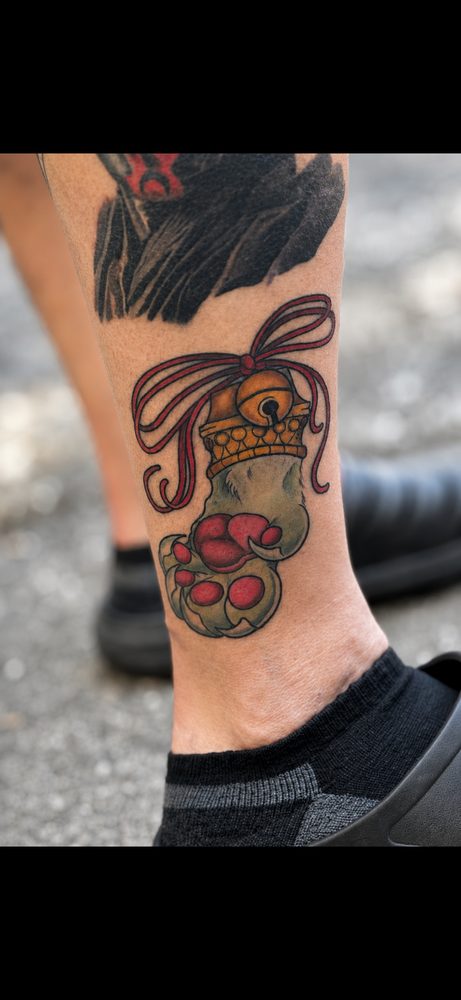
Recent black-and-grey work
Black-and-grey questions
Does black-and-grey age better than colour?
Generally yes. Black ink holds its density longer than most colours, and black-and-grey work tends to keep its contrast well over decades — provided the piece was built with enough separation between tones to begin with. That's the real variable: a black-and-grey design with genuine range from deep black to soft grey ages far better than one crowded into a narrow middle band.
What's the difference between black-and-grey and blackwork?
Black-and-grey uses diluted black to build a full range of tones — think soft shading, gradients, depth. Blackwork leans on solid, saturated black shapes with hard edges and little or no grey. Ornamental and dotwork pieces often blend the two. We'll figure out which one your idea actually wants at the consultation.
Is dotwork the same thing?
Dotwork builds tone out of stippled dots instead of smooth shading. It has a distinct texture — quieter, more etched, almost engraved-looking — and it suits ornamental and botanical work especially well. It's slower to lay in than smooth shading, which is worth knowing when we talk about time.
Can black-and-grey cover an old tattoo?
Sometimes, but it's harder than colour. A cover-up needs to be darker than what's underneath, and black-and-grey gives fewer places to hide old linework than a saturated colour piece does. If you want black-and-grey over existing work, see the honest version on the cover-up page — laser fading first often makes it possible.
Does black-and-grey hurt less?
No — pain comes from placement and session length, not from ink colour. What can differ is time: heavy black saturation takes passes, and large areas of solid black are among the more demanding things to sit for.